
Running technique can reduce injuries and improve performance!
Proper Running Technique – Good running technique can help make you a better, healthier and more efficient runner. Just as other sports involve training and learning technique for more efficient participation and injury prevention, running is also a skill that requires training. Running is an activity that involves no physical contact, yet the injury rate is high.
How Did I Get Started?
After quite some time, I can conclude that I have devoted considerable personal study to running technique. My first contact with it was when I was 8, through the book Dr. Tom Miller’s Programmed to Run. My interest in running technique also stemmed from my father, who ran for most of his career without cartilage in his knee and had to adopt excellent running technique that would protect him and allow him to continue his favourite activity without aggravating the problem. My father started running several years after injuring his knee while playing college football. His doctors told him that he would never be able to run again and that even his gait would not be normal because of the injury. As the doctors had diagnosed, they were mainly right about the alteration of his normal gait. My father weighed 108 kilograms, like a weightlifter. Shortly afterwards, a friend sent him a card that read: “Hawk Harper, if you are a real man, you will be able to do this.” The card was from the Las Vegas Marathon. My father finished the marathon in considerable pain and was the last athlete in the race. Eventually, some time later, he watched Kenyan runners and thought… “These guys fly… I bet that if I learn to run like them, my knee won’t hurt.” Seven years later, weighing 60 kilograms and aged 37, he managed to win the St. George Marathon in 2:22. My father succeeded in developing highly efficient running technique without overloading his body, maintaining his knees and the rest of his body in good physical condition throughout the rest of his career. My father is now in his seventies and still enjoys running every day on roads and in the mountains.
Below are the 4 important points that enhance running technique!
The 4 basic points of good running technique are those observed by my father in Kenyan runners. They are the elements identified through research on high-level athletes and on college runners who did not experience injuries during their running careers or later.
Over time, this information has been modified—not to perfect technique with absolute precision, but to provide the most effective cues for better results for the now enormous population of runners.
The following video briefly presents the 4 basic elements analysed below:
-
Proud posture
“Run proud, run tall”
During work, most runners allow their bodies to remain in the usual poor computer “keyboard“ posture (a hunched-back position). Unfortunately, this body position also appears during running. If you want to improve your body position while running, you need to forget the body’s poor computer posture.

An efficient body position requires you to straighten your back and push your chest and hips forward. This position helps you immediately correct your body position and make your next steps more efficient. Keep your shoulders behind your chest in a relaxed position, with your back remaining straight and without bending at the waist. Keep your gaze straight ahead, with your head aligned with your neck. Do not lift your chin or look down at your feet.
Tell yourself: “Run proud, run tall” and adopt the correct body position, with your hips and chest supporting forward body propulsion.
Quick Tip: “Moon bounce ” If you want to correct your body position, open and raise your arms upwards at a 45-degree angle as if you were trying to bounce to the moon. This movement helps your chest and hips move into the correct body-propulsion position. Continue to keep your back straight and your centre of mass engaged.
2. Compact arms
Excessive arm movement, as if propulsion were being generated through the arms, is another problem in runners’ technique. Arm movement in elite runners is limited. Elite athletes keep their palms quite high, in a position resembling brushing their sides with their wrists. The elbows move alternately: one makes a quick movement backwards, followed by a passive return. Finally, the arms move in a straight line parallel to the body, from back to front, rather than diagonally from the side inward.
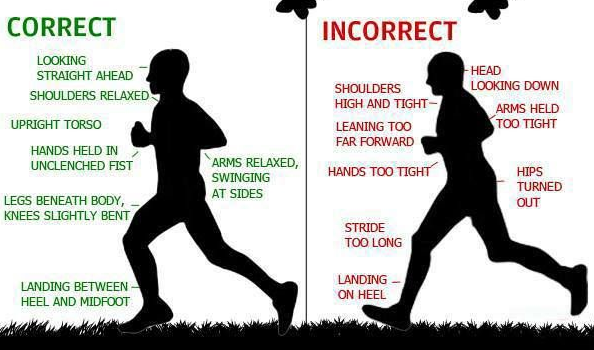
To be more efficient, keep your arms close to your body at an angle of approximately 90 degrees. In contrast, most runners hold their arms low and quite far away from their bodies. Unless you are sprinting, do not let your elbows pass your hips or your wrists move in front of the centre of your chest. On average, a runner moves at 10 min/mile, so it would be better to have only 3 seconds in the arm movement.
Think of: “Chicken wings” or “Wrists to the ribs”
- Small, limited movement with a relaxed arm swing
- Drive the elbow backwards and allow a relaxed return forwards
- The elbows should not come in front of the waist, except at high speed.
Tip: Use light weights or water bottles weighing half to one kilogram in your hands during an easy run. This will help you find the most effective arm position and elbow angle.
3. Bent knee on landing
Correct foot impact with the ground is the result of correct body position, compact arm movement and the correct stride frequency. Hard foot impact with the ground plays an important role in the onset of rapid fatigue, muscle cramps and other problems that should be avoided.

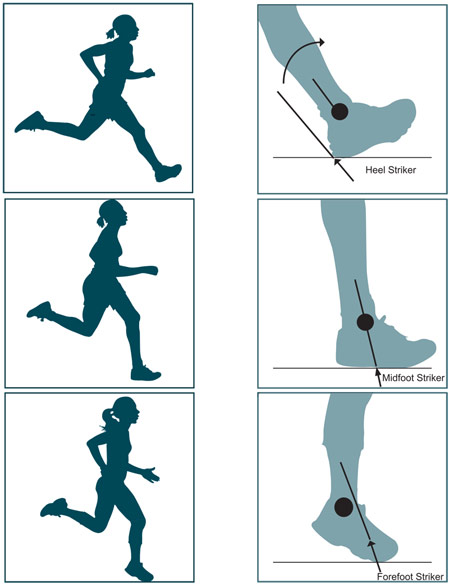
Every runner has developed their own unique technique for landing, influenced by genetic factors, running surfaces and running speed (execution ability). A runner’s efficient foot strike occurs at the midfoot. Landing slightly in front of or behind the midfoot is efficient when it occurs beneath the body’s centre of mass. Excessive landing on the heel and toes causes very hard foot impact with the ground (an inefficient movement).
Tip: Keep in mind: “Run quietly.” The more audible your movements are, the more unnecessary movements you are making. Alternatively, try to bend your knee while running!
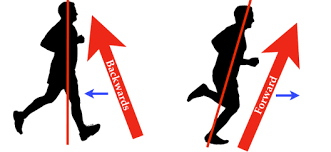
Try to ensure that your foot strike is not far from the body’s vertical line (overstriding). Also, try to prevent your heel from making contact during the foot’s contact with the ground (Heelstrike).
5. Stride frequency 165 +
After analysing elite athletes and individuals with a limited history of injuries, it was found that running cadence varies according to running speed. The former tendency to use 180+ steps per minute is now considered ineffective at low speeds and is more applicable to athletes running at a pace of 7 minutes/1 mile. In addition, even these elite athletes did not run at 180+ at lower speeds; the lowest their cadence dropped to was 165 steps per minute. Research found that an average runner can reduce the forces developed in the joints by up to 20% by managing to increase their cadence by as few as 10 steps per minute of running. Below is an indication of stride frequency (steps per minute) in relation to running speed.
| 165+ steps/minute: 10 minutes/mile and slower pace |
| 170+: steps/minute: 9 minutes/mile pace |
| 175+: 8 minutes/mile pace |
| 180+: 7 minutes/mile pace and faster |
I recommend downloading a metronome app on your phone to help you run to the corresponding beat.
You can check your stride frequency in a simple way: count how many times your right foot hits the ground within 20 sec. For example, 28 steps (162 steps per minute) up to 30 steps equals 180 steps per minute.
If phone apps are not practical for you, you can use a musical metronome, such as a piano. Set the metronome to the correct tempo for a more efficient stride frequency while running.
Original Article: Running Technique Can Reduce Injury & Improve Performance
Author: Golden Harper
Translation: Kyriaki Mitrou M.Sc.