
Myths and Problems with “Traditional” Shoes.
Myth 1: Modern shoes reduce injuries.
Reality:
Research and technology have advanced footwear with the aim of reducing injuries; however, in practice, modern shoes have not only failed to reduce injuries, but some foot problems have actually increased to a greater extent (1).
The belief that new footwear technology will solve foot problems is one of the most prevalent myths. It is based not on science, but on marketing and modern shoe design. None of the traditional shoes has been proven to protect your feet from injuries (2).
Why? Read on
Myth 2: New shoe cushioning technologies will protect your feet from injuries.
Marketing in shoe cushioning technology was based on the classic message: “The Gel in Asics shoes will save your feet,” or “Run however you want—the cushioning technology in your shoes protects you.”
Reality: Research has shown that cushioning does not protect the joints (3). On the contrary, the more cushioning we use—especially in the heel—the more impact forces on the joints increase (the kinetic chain involving the knees, hips, lower back, etc.) (4).
In reality, shoes with a pronounced, raised heel cause sudden braking during the body’s natural movement, resulting in increased impact forces against the ground (5). The more cushioning there is in the rear of the shoe, the harder our body instinctively lands on the ground.
Solution: Foot-shaped shoes with no raised heel (Zero Drop) allow the body to land naturally and absorb impact with the ground through the body itself. By bending the knee and spreading the toes on the ground, the body is able to absorb shock using its own mechanical mechanisms. These shoes provide sufficient protection, but do not have a raised heel or elevated heel structure that encourages the body to land on the ground inefficiently.
Note:
Cushioned shoes protect the feet to a certain extent, but not the knees. A common example is boxing gloves, which protect the hands from blows but not the athletes’ shoulders,
so the number-one injury among boxers is shoulder injury.
Myth 3: Traditional shoes help athletes run better
Reality:
Shoes with a raised heel have negatively affected the way most athletes run, leading to an increase in injuries (as mentioned above). Fifty years ago, before shoes were redesigned with a raised heel and a large, heavy heel, it was rare to see a runner over-stride or land hard on their heel in front of their body—see Figures 1 and 2.
A Harvard study conducted on 20,092 runners who over-stride showed that they had three to five times greater contact time compared with a vertically aligned body position, even when wearing the best running shoes on the market with the best cushioning.
Figure 1. 
Solution: Zero-drop shoes (Figure 4) do not have a heavy, raised heel and have the same height from the heel to the front of the foot. This allows the body to land on the forefoot and helps avoid over-striding. A 2016 study at Northern Iowa University (7), which compared some of the best shoes on the market, showed that a runner’s foot strike and landing are affected by the drop of the shoes.
Figure 2.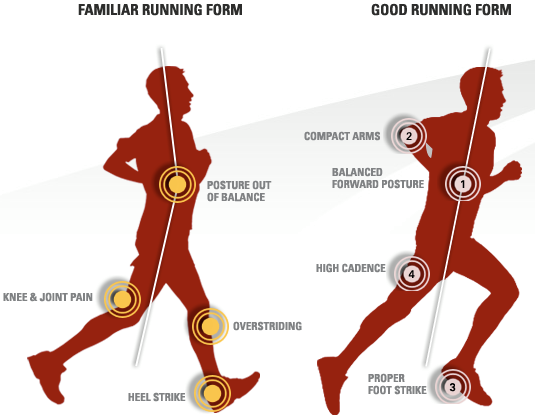
Figure 3. 
Myth 4: “Good,” supportive, advanced shoes will prevent or cure foot problems.
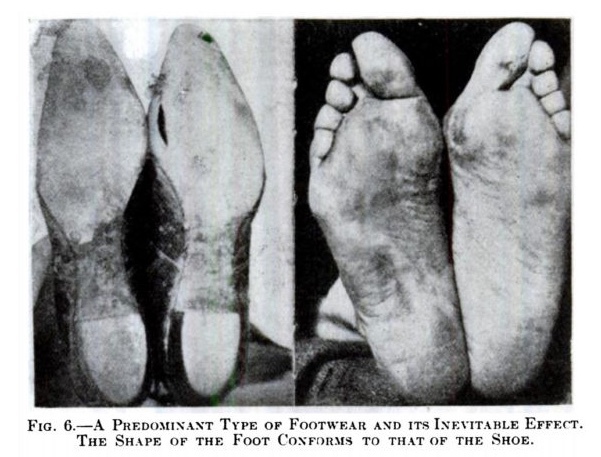
Reality: Research in the United States has shown that 73% of the population reports annual foot pain. In populations where people walk barefoot or do not wear supportive footwear with a pronounced heel and a narrow toe box, the incidence of foot problems is only 3%. These populations do not experience the most common modern foot conditions, such as vascular problems, neuromas, plantar fasciitis, injured toes, etc. (9) (10). Almost all of our foot pain and problems originate from modern shoes, which completely alter the natural anatomy of our feet—see Figure 3—including a raised Achilles tendon, pressure on the arch and changes to the natural position of the toes.
Solution: Foot-shaped shoes with no raised heel (Zero Drop) allow our feet to remain in their anatomical and natural position, combined with cushioning and protection for the soles from hard surfaces.
Myth 5: Overpronation causes injuries and supportive shoes (stability shoes or support shoes) will correct the problem.
Reality:
More than 200 studies have been conducted on overpronation and injuries, and no significant connection between the two has been demonstrated (11). In other words, although it may sound ironic, the shoes designed to correct the problem do not work effectively. Laboratory studies show that supportive shoes correct foot strike, but not the actual problem occurring in the foot inside the shoe. In fact, some studies have shown that people who overpronate experience fewer injuries. The Calgary clinic that studies running-related injuries conducted a six-year study involving 4,000 runners and found that only 15% of runners benefited from wearing supportive shoes (stability shoes or support shoes), while most did not correct their overpronation problem (12). The majority of the population shows that injuries are less common when wearing a shoe that allows the body to function naturally.
Solution: Foot-shaped shoes (Foot-shaped) (Figure 4) with no raised heel (Zero Drop) allow the foot to do what it is truly designed to do in its own natural way: absorb impact effectively and stabilize the foot strike. Research indicates two factors that minimize injuries: a) comfortable shoes and b) shoes that allow the individual to learn to run with the body’s natural “movement pattern”—that is, to run as if barefoot.
Figure 4.
Myth 6: Injuries are caused by running on hard surfaces.
Reality: Most injuries are likely to be caused by muscular imbalances that develop through the repetitive movement of running and abnormal movement, often caused by shoes with raised heels. Soft-profile surfaces, such as tracks and artificial turf, are much more strongly associated with injuries than natural surfaces (uneven terrain), which allow different strides to develop. Natural surfaces may be hard and rocky, but they encourage a more natural foot strike and muscular distribution because every step is different and they require activation of the body’s natural technique.
Solution: One-third of training on trails with rocks, grass and, generally, technically challenging surfaces is an excellent training choice with less strain (14). Zero-drop, foot-shaped shoes are an excellent choice for mountain running because they allow the foot to make maximum adaptations naturally, and they are the number-one shoe choice among more experienced ultradistance runners.
Based on the research background above, the American College of Sports Medicine recommends foot-shaped shoes without a heel (zero drop). The ideal running shoes have the following characteristics:
Shoes with zero drop are the ideal choice.
Neutral: Shoes should not include additional features that alter the natural foot strike.
Lightweight.
There should be sufficient room in the toe box so that the toes can spread into their natural position.
Traditional shoes to avoid:
Shoes with excessive cushioning, a high heel and low cushioning in the forefoot.
Narrow toe box, resulting in an unnatural spreading of the toes and the small bones of the foot during running and walking. The toe box will relieve pressure on the soles during the foot’s landing on the ground.
Research references:
[1] Van Mechelen W. Running injuries. A review of the epidemiological literature. Sports Med. 1992; 14(5):320-35. Nigg B, et al Br J Sports Med 2015;49:1290-1294.
[2] Richards, et al, University of Newcastle, 2009.
[3] Lieberman, et al, 2009.
[4] Kerrigan, et al, 2009.
[5] Robbins and Hanna, 1987; Robbins et al., 1989; Robbins and Gouw, 1990
[6] Nigg, et al, Calgary, 1997
[7] Ficklin, et. al, University of Norther Iowa, 2016
[8] 2010 APMA Annual Report
[9] Schulman, 1949, Jamaica, NY
[10] I.B. Shine, 1962, St. Helena
[11]www.BartoldBiomechanica.com , 2015
[12] Ferber R, et al Running Injury Clinic, Calgary: Green Runner Study
[13] Nigg B, Baltich J, Hoerzer S, et al Running shoes and running injuries: mythbusting and a proposal for two new paradigms: ‘preferred movement path’ and ‘comfort filter’ Br J Sports Med 2015;49:1290-1294.
[14] Harper, 2005, Brigham Young University
[15] 2017 Observed Footwear Choices, Western States Endurance Run 100 Mile Race. iRunFar: Your Trail Running & Ultramarathon Resource
Original Article: Golden Happer, on April 24, 2018
Text editing: Kyriaki Mitrou, MSc, graduate of the School of Physical Education and Sport Science, Aristotle University of Thessaloniki.